


To download this document as a PDF, click here.
What are Artificial Turf and Playgrounds Made Of? What is Their Impact on Health?
Is your child playing on rubber and plastic instead of grass? Grass has been replaced with artificial materials at schools and parks all over the country. But there is clear evidence they can be harmful to children and adults.
Unfortunately, artificial turf increases “turf burn” abrasions from sliding, limb injuries and concussions, and can become dangerously hot in the sun. PFAS and other endocrine (hormone) disrupting chemicals can contribute to numerous health problems, as described below.
So why are artificial turf fields and synthetic playground surfaces so popular? Artificial turf was installed in the Houston Astrodome football field in 1966. Nobody was talking about the risks of microplastics, PFAS, other hormone-disrupting chemicals, or recycled tire crumb in 1966. We know much more now than we did then.
Recycling Tires to Create Playgrounds
Using millions of recycled rubber tires seemed like a great idea at first – why not keep them out of landfills and provide a softer landing on the playground? It was known that burning old tires released harmful, smelly chemicals into the air and groundwater, but parents didn’t realize that recycled tires and new rubber used on fields and playgrounds can also be dangerous.
You may think of rubber as a natural product from rubber trees, but rubber is a mix of latex from rubber trees mixed with petroleum products, and old tires contain metal, too. That means recycled rubber can include lead, phthalates, polycyclic aromatic hydrocarbons (PAHs), volatile organic compounds (VOCs), and other chemicals known or suspected to harm human health.
Phthalates and other chemicals that disrupt hormones increase the chances of developing obesity, early puberty, asthma, and attention problems. Research reported that infants and children exposed to phthalates were more likely to develop childhood cancers. In addition, federal agencies warn that breathing air contaminated with PAHs may increase the chance of developing cancer and birth defects.
Why Aren’t They Proven Safe?
There is no government agency that requires synthetic playground surfaces to be tested before they can be sold. In fact, the materials used are often not made public — that lack of information is justified as “trade secrets.”However, some researchers have independently examined the safety of these playground surfaces.
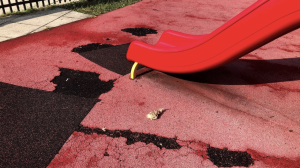
In 2019, Washington, D.C. admitted that 17 of their playgrounds had dangerously high levels of lead. That same year, the nonprofit Ecology Center tested the crumb rubber found on the broken rubber surfaces of several playgrounds and found that some of the pieces had levels of lead that were more than 1,000 times higher than considered safe.
A 2015 report by Yale scientists analyzed tire mulch samples used for school athletic fields and playgrounds. Most of the 96 chemicals they detected had never been carefully studied, so their health risks are unknown. However, 20% of the chemicals that had been tested are considered to probably cause cancer. In addition, 40% are irritants that can cause breathing problems such as asthma, and can irritate skin or eyes.
What About Your Schools or Parks?
Here are a few of the materials that have known risks due to lead and hormone-disrupting chemicals:
- Loose tire shred (rubber mulch) used on plastic “grass” fields as an infill or sold to homeowners to use around plants or under swing sets.
- Tire shreds or colorful “virgin” rubber combined with a binder and then poured onto a permanent surface, or factory-molded and then glued to a playground surface, or “poured in place” (PIP) on top of loose tire crumb.
Children are much more likely to be harmed by chemicals in their environment than adults because they are smaller (so the exposure is greater) and because their bodies are still developing. Pregnant women should be even more careful to avoid these exposures.
Parents in many communities are persuading local officials to conduct safety tests on artificial turf fields every year, and to install grass or wood chips because they are safer in terms of chemical exposure, heat, and if their children fall.
PFAS chemicals are of particular concern because they enter the body and the environment as “forever chemicals,” which means that they are not metabolized and do not deteriorate, accumulating over the years.
Although manufacturers often claim that their products do not contain PFAS, that is based on very limited testing. There are thousands of PFAS chemicals, and only a few are tested for. Several worrisome PFAS chemicals have been found by independent researchers studying artificial turf, including but not limited to BrockFILL artificial turf. Although BrockFILL claims it “meets the requirements of the FIFA quality programme for synthetic turf systems as well as those of World Rugby” those requirements do not evaluate long-term safety for either children or adults. Unfortunately, there are zero testing criteria for artificial turf materials’ long-term safety, making such claims meaningless.
Plastic grass itself exposes children and adults to dangerous levels of PFAS, microplastics, and other toxic chemicals as well. The fields and playgrounds deteriorate due to weather and use, and that results in the emission of chemicals and microscopic particles into the air. “Particulate matter” from microplastics and other materials can be inhaled while playing or even sitting nearby, causing serious lung damage and other health problems. Microplastics from plastic materials have been found in the human brain, lungs, heart, liver, and testicles. Research suggests that they can cause heart disease, lung disease, infertility, and dementia.
Injuries
Warranties for most artificial turf fields require annual tests to check for hardness, called GMax scores. One community found that 37 of their 51 fields failed and needed to be replaced.
Artificial turf and rubber playgrounds retain heat. On warm or sunny days, the heat in the air on the field can be 50-60 degrees hotter than natural grass. That can cause heat poisoning as well as burns.
Other injuries include turf burns and musculoskeletal injuries such as ACL tears, ankle sprains, and muscle strains. That’s a major reason why players’ associations of the NFL and Men’s and Women’s Soccer oppose artificial turf fields.
Why are chemicals that are banned from children’s toys allowed in artificial turf and playground surfaces?
The Consumer Product Safety Commission has banned several hormone-disrupting chemicals from pacifiers and teething toys, even though they would result in very short-term exposures compared to artificial turf or playground surfaces.
For more information, see www.center4research.org