


Written by Farmin Shahabuddin, MPH & Katelyn Reynolds, DrPH, MPH
Most people know sunscreen helps prevent sunburn and skin cancer. But there are important things many people do not know: how much sunscreen you really need, what SPF numbers mean, surprising places where skin cancer can show up, how we know sunscreen helps prevent cancer, and what scientists are still learning about sunscreen ingredients.
Why Sunscreen Matters from Childhood Through Adulthood
Sunlight contains ultraviolet (UV) rays that can damage the DNA inside skin cells. Over time, that damage can cause sunburn, wrinkles, dark spots, and skin cancer. Both UVA and UVB rays can damage your skin, which is why it is important to choose “broad spectrum” sunscreen, which protects against both. The sun exposure you get when you are young can also affect your skin years later. A study of more than 116,000 U.S. women found that those who had heavy sun exposure and tanning-bed use during the high school and college years were more likely to develop basal cell carcinoma in life. That is the most common and least dangerous type of skin cancer. Those who had severe sunburns during the teen years were also more likely to develop basal cell skin cancer. The results were not clear from other types of skin cancer, but it adds to the evidence that protecting your skin early in life matters.1
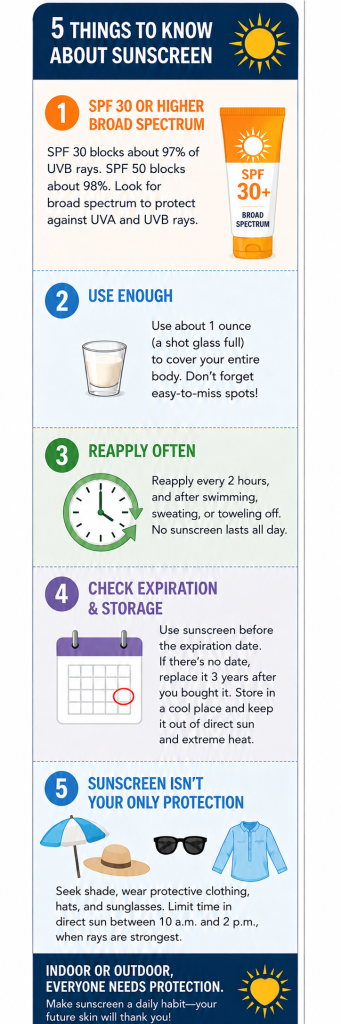
What Sunscreen Should You Use? 15? 30? 50? 100?Look for two things on the label: broad spectrum and SPF 30 or higher. Broad spectrum means the sunscreen protects against both UVA and UVB rays. SPF 30 blocks about 97% of UVB rays, while SPF 50 blocks about 98%, which is not enough of a difference to matter to most people. That also means SPF 100 is not much more protective than either SPF 30 or 50. A higher SPF also does not mean you can use less sunscreen or stay outside longer. No sunscreen is waterproof, so if you will be swimming or sweating, choose a sunscreen labeled water resistant. Yes, Sunscreen ExpiresCheck the expiration date before using sunscreen. If there is no date, FDA says to consider it expired three years after you bought it. Heat and direct sunlight can also affect sunscreen, so avoid leaving it in a hot car or sitting in direct sun for long periods. If you cannot remember how old the bottle is, replace it. Most People Do Not Use EnoughAn average-sized adult needs about one ounce of sunscreen, roughly a shot glass full to cover exposed skin on the body. Apply it about 15 minutes before going outside and reapply at least every two hours. Reapply sooner after swimming, sweating, or drying off with a towel. Do not forget your ears, the back of your neck, hands, feet, lips, hairline, and any exposed areas of your scalp. |
 |
How Do We Know Sunscreen Prevents Skin Cancer?
It seems like a simple question: If sunscreen is intended to prevent skin cancer, how do we know that it actually works? Most of the evidence is indirect. Sunscreen prevents sunburn and reduces the amount of UV radiation that reaches your skin. UV radiation and sunburn are both known causes of skin cancer. Research that combined 51 smaller studies found that the chances of developing melanoma, a potentially fatal form of skin cancer, increased as the number of sunburns increased. This was true for sunburns at any time, from childhood through adulthood.2 Sunscreen has also been tested more directly. In an Australian study, 1,621 adults were randomly assigned either to apply sunscreen every day or to use it at their discretion. The daily-use group included 812 participants, and the discretionary-use group included 809. Daily sunscreen use did not clearly reduce basal cell carcinoma, but it reduced the rate of squamous cell carcinoma growths by 39 percent.3 However, 10 years after the study ended, 11 people who had previously been assigned to use sunscreen every day had developed melanoma, compared with 22 people who had been assigned to use sunscreen as they normally would. That difference was just short of statistical significance, which is what researchers usually consider strong enough evidence to rule out chance. However, invasive melanomas—cancers that had grown deeper into the skin—were significantly less common among people assigned to use sunscreen every day.4 This shows that sunscreen may protect against some types of skin cancer more than other types. There are not many studies of people’s sunscreen habits lasting many years, and of course, there is no way to know how accurately people describe their use of sunscreen. But taken together, the evidence is persuasive that using sunscreen helps prevent skin cancer.
Skin Cancer Can Be Easier to Miss on Darker Skin
Skin cancer is less common in people with darker skin, but when they develop melanoma, it is more likely to be found at a later stage, when it is harder to treat. About 52% of Black patients and 26% of Hispanic patients already have advanced melanoma when they are diagnosed, compared with about 16% of White patients. Later diagnosis also means fewer patients survive at least five years after diagnosis. Surprisingly, for people with darker skin, about 60% to 75% of melanomas are found on the palms, soles of the feet, or around or under the nails. The sole of the foot alone accounts for about 30% to 40% of cases. These areas can be easy to overlook, so they are important to check too.5
What About Chemicals in Sunscreen?
You may have heard concerns about chemicals in sunscreen. Several commonly used ingredients—including oxybenzone, avobenzone, octinoxate, and octocrylene- can pass through the skin and be found in the bloodstream. Finding an ingredient in the blood does not mean it will cause harm, but researchers are studying these chemicals to understand their impact, especially oxybenzone, which is known to affect hormones.6
FDA has said that it needs more safety information about several sunscreen ingredients that have been used for years. Sunscreen is regulated in the United States as an “over-the-counter” drug, meaning it can be sold without a prescription. Sunscreens are sold under FDA rules that set requirements for each ingredient, labeling, safety, and effectiveness. That makes it impossible to compare the safety of different sunscreen products that are sold.
The harm caused by too much UV exposure is well known, while questions about some sunscreen ingredients are still being studied. If you would rather avoid these uncertainties, mineral sunscreens containing zinc oxide or titanium dioxide have the most complete safety information.
A New Sunscreen Ingredient After Decades
In June 2026, FDA added bemotrizinol as an allowed active sunscreen ingredient—the first new active ingredient added to U.S. sunscreen rules in decades. Bemotrizinol has been used in Europe and many other countries for years. It protects against both UVA and UVB rays and very little is absorbed through the skin, so little will get into the bloodstream. After reviewing the evidence, FDA determined that bemotrizinol had enough safety and effectiveness data to be used as an active ingredient in U.S. sunscreens for adults and children 6 months and older. Its addition gives U.S. consumers another option.7
What About Babies and Children?
For babies younger than 6 months, shade and protective clothing should be the first choice. Keep babies out of direct sunlight as much as possible and use lightweight clothing, hats, stroller canopies, and shade. If shade and clothing are not available, the American Academy of Pediatrics says a small amount of sunscreen can be used on exposed areas such as the face and backs of the hands. For babies 6 months and older, use broad-spectrum SPF 30 or higher and reapply it regularly.
References
- Tran, M. M., et al. (2024). A prospective cohort study exploring the joint influence of sunlight exposure and tanning bed use on skin cancer risk. Archives of Dermatological Research, 316(6), Article 281.
- Dennis, L. K., et al. (2008). Sunburns and risk of cutaneous melanoma: Does age matter? A comprehensive meta-analysis. Annals of Epidemiology, 18(8), 614–627.
- Gordon, L. G., Scuffham, P. A., Van Der Pols, J. C., McBride, P., Williams, G. M., & Green, A. C. (2009). Regular sunscreen use is a cost-effective approach to skin cancer prevention in subtropical settings. Journal of Investigative Dermatology, 129(12), 2766-2771.
- Green, A. C., et al. (2011). Reduced melanoma after regular sunscreen use: Randomized trial follow-up. Journal of Clinical Oncology, 29(3), 257–263.
- Skin Cancer Foundation. (2025). Skin cancer in skin of color; American Academy of Dermatology. (2025). Finding skin cancer in darker skin tones.
- Jaskulak, M., et al. (2025). Endocrine and reproductive health considerations of sunscreen ingredients. Current Environmental Health Reports, 12(1), Article 28.
- U.S. Food and Drug Administration. (2026, June 9). FDA expands sunscreen options for the first time in 20 years.